production automations shipped in a single flagship stack where workflow and integrations were unified end to end
Applied systems
Agentic Marketing Systems & Internal Workflow Leverage
Less manual drag in the places work actually happens — routing, follow-up, internal tools, and the handoffs between them.
When the same questions, approvals, and follow-ups keep landing on people because nothing in the stack closes the loop, velocity suffers and mistakes become normal. That is usually not a “motivation” problem. It is a workflow and systems problem. This work is about applied leverage: mapping where time leaks, where handoffs break, and where a combination of automation, internal tooling, and structured AI assistance can replace brittle manual habit with something the team can actually run. It sits next to CRM architecture — CRM is the spine; this is the orchestration layer, internal surfaces, and operational logic that make marketing and sales operations easier to execute day to day. It is not a slide deck about the future of AI. It is build-ready thinking that connects to real tools, APIs, and processes already in your business.
Typical investment$4K–$30K+ · Scoped by workflow depth, integration count, and build surface
Audit snapshot
manual time reclaimed in that environment once repetitive operational load moved into systems
internal tools and workflows built to run — not proofs-of-concept or one-off demos
Signs you need this
- The same operational tasks keep eating hours — routing leads, updating records, chasing status, pulling numbers for meetings — and everyone knows it should not be that manual.
- Handoffs between marketing, sales, and ops depend on people remembering the next step instead of the system enforcing it.
- You have tools, but the workflow between them is weak: data does not arrive where the next person needs it, when they need it.
- Teams are experimenting with AI in the open, but there is no shared structure — outputs, safety, and ownership are inconsistent.
- Reporting and follow-up feel like a separate job instead of a byproduct of how the work is already done.
- You have already cleaned up CRM stages or run an audit, but execution still feels heavy — the “last mile” of daily work never got systemized.
- You want practical internal leverage — not a transformation program — and you are ready to tie it to specific processes and outcomes.
What this usually includes
- Internal workflow and friction audit — where work is repeated, where follow-up depends on memory, and where routing or reporting still lives in spreadsheets or side channels
- High-leverage process prioritization — which sequences to systemize first based on volume, risk, and revenue impact (not “automate everything”)
- Workflow and handoff logic design — triggers, ownership, exceptions, and how data should move between CRM, ops tools, and customer-facing surfaces
- Applied AI and internal tool direction — where assisted support, classification, drafting, or retrieval actually reduces load without creating a parallel mess of ad hoc prompts
- Automation and integration blueprint — what to build natively in the stack vs. what needs custom glue, webhooks, or lightweight internal apps
- Rollout and adoption roadmap — phased delivery, testing, training hooks, and how this connects to a MarTech audit finding or a CRM architecture pass when those came first
Common questions
Related proof
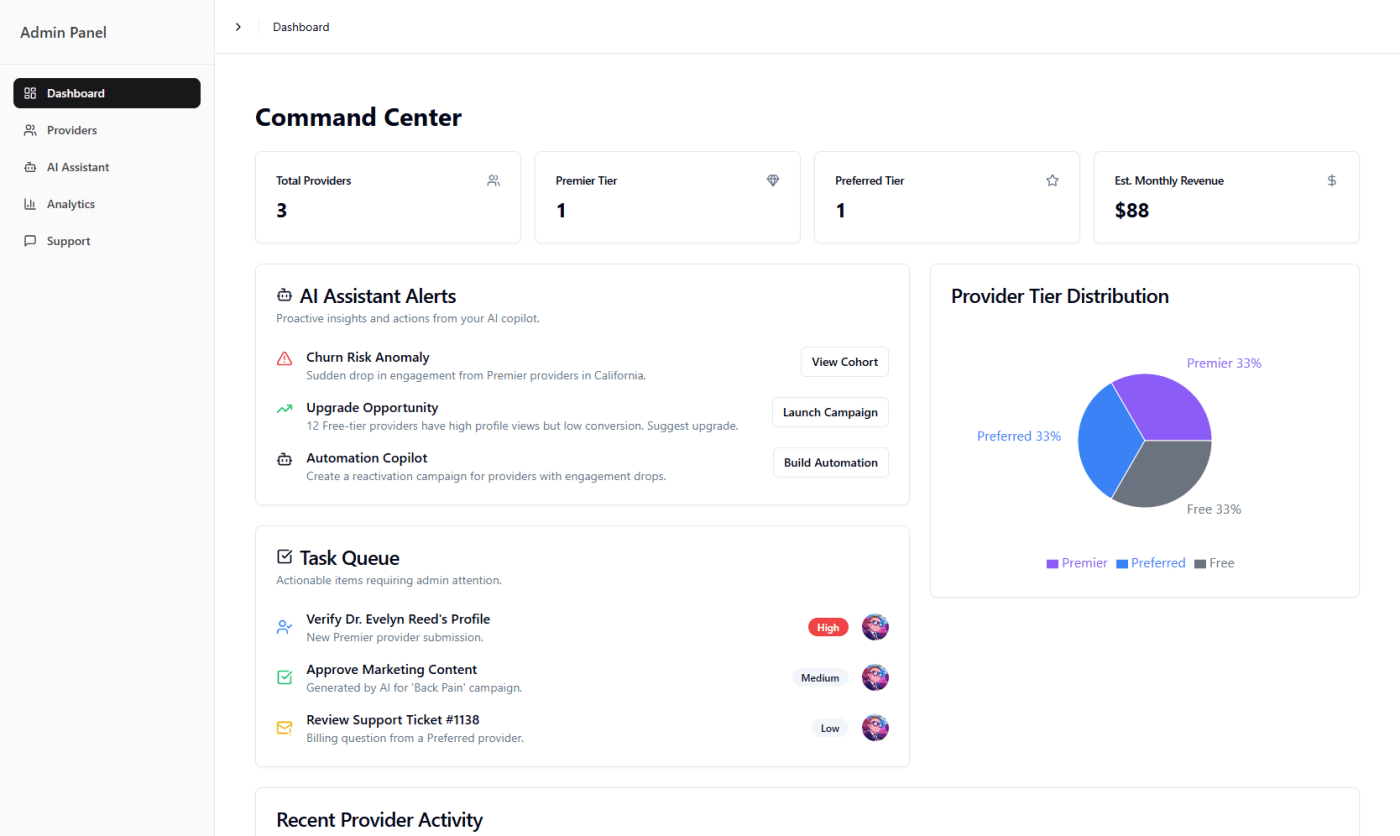
Live build
See the Graston Growth Engine in action.
A two-sided provider directory with real-time spatial search, AI-powered support automation, and a per-provider analytics dashboard — built as a production system, not a demo.
Related case studies
Related services
CRM & AutomationAgentic SystemsLead Gen WorkflowsHealthcareSaaSE-CommerceB2B
Ready to get started?
I work with a small number of clients at a time. Every engagement gets my full attention.